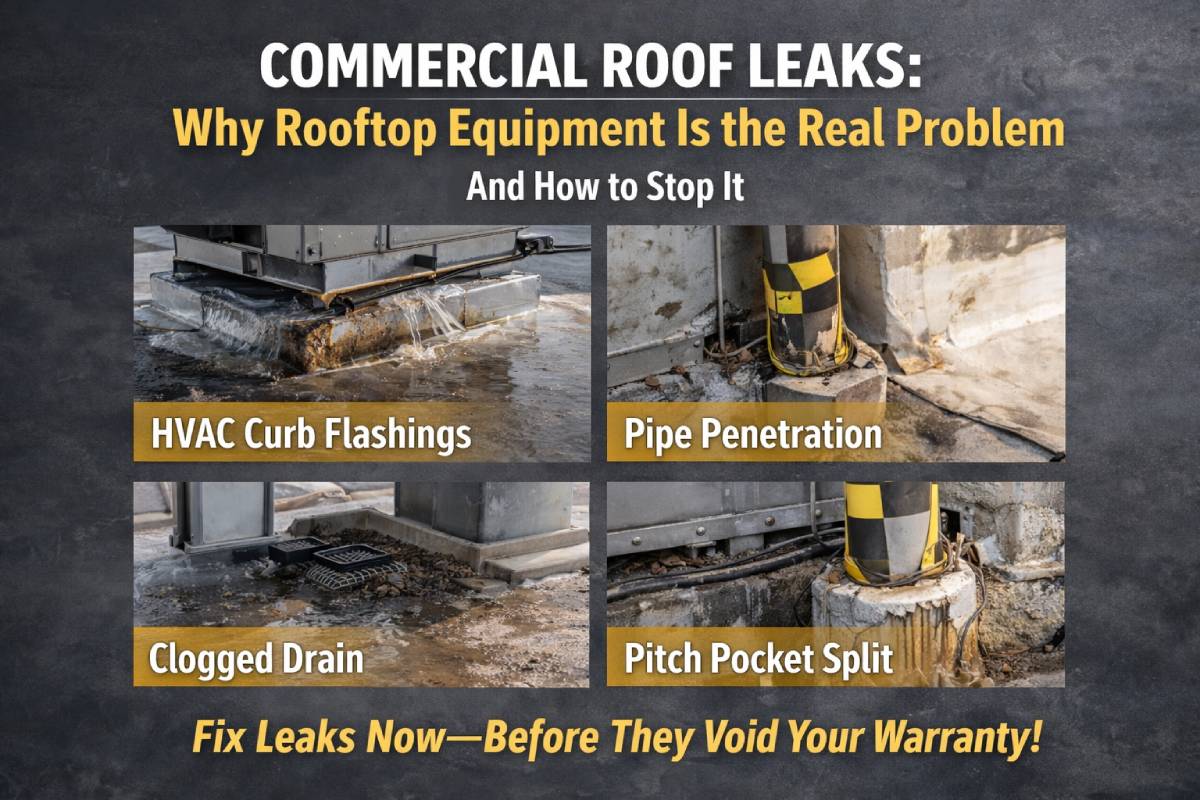
Commercial Roof Leaks: Why Rooftop Equipment Is the Real Problem (And How to Stop It)
Commercial roofs rarely fail “in the middle of the field.” Most water intrusion starts at details—the places where the roof is interrupted by equipment, pipes, drains, or edges.
In 2026, that’s a bigger issue than ever because buildings are adding and upgrading rooftop systems: HVAC retrofits, electrical conduit, internet equipment, solar, and more. Every add-on creates a new penetration—and a new leak opportunity if it’s not detailed correctly.
Below is the practical guide property managers use to reduce leaks and protect roof life.
1) The Big Five water intrusion zones on commercial roofs
Here’s where we see the most recurring problems:
- HVAC curbs and transitions
- Conduit/pipe penetrations (especially “after the fact” installs)
- Pitch pockets / penetration pockets that shrink or split over time
- Drains, scuppers, and overflow drains
- Parapet walls, coping metal, and terminations
Many of these are addressed in best-practice guidelines from National Roofing Contractors Association, which emphasizes proper detailing and maintenance at roof edges, penetrations, and flashings.
2) HVAC curbs: the “movement” problem
HVAC units vibrate. Curbs expand/contract. Service techs walk around them. That movement stresses flashing over time.
What good curb detailing includes:
- Compatible membrane flashing materials
- Correct termination height and securement
- Protection where foot traffic happens most
Common failure signs:
- Cracked sealant lines
- Loose termination bars
- Splits at corners
3) Pitch pockets: convenient, but maintenance-sensitive
Pitch pockets (also called penetration pockets) are sometimes used when penetrations are irregular or hard to flash with prefabricated parts. Industry guidance notes they’re often treated as a “last alternative,” and their sealant fill requires ongoing maintenance.
If your roof has pitch pockets, don’t ignore them—they’re not “set it and forget it.”
For some systems, manufacturers offer purpose-built pitch pocket accessories designed to seal difficult penetrations (instead of improvised field builds).
4) Drains and scuppers: small clogs, big consequences
Drainage issues don’t just cause ponding—they can force water into seams and terminations.
Minimum owner checklist:
- Keep strainers clear
- Confirm water flows after a hose test
- Watch for staining that indicates “dirty ponding”
If you manage multiple properties, document drain conditions during each inspection so patterns are obvious.
5) “Other trades” are a top cause of roof damage
A perfectly installed roof can be compromised by later work—HVAC service, electrical additions, security cameras, satellite/internet upgrades.
One classic industry rule: no new penetrations without the roofing contractor involved—because the roof’s waterproofing system is specialized. Older NRCA guidance also warns against allowing uncoordinated equipment installations and uncontrolled roof traffic.
6) Best-practice policy: require a roof penetration protocol
If you’re a property manager, write this into vendor rules:
- Any penetration must be reviewed by roofing
- Use manufacturer-compatible flashing materials
- No “mastic-only” fixes
- Photo documentation before/after
For single-ply systems, manufacturers like Johns Manville publish flashing installation guidance intended to integrate penetrations correctly into TPO/PVC/EPDM assemblies.
7) A simple commercial maintenance cadence that works
Twice per year (plus after major wind/rain events):
- Walk the perimeter and terminations
- Inspect all penetrations and curbs
- Clear drains/scuppers
- Check roof-top-traffic area
This approach reduces surprise leaks and helps you budget planned repairs instead of emergency calls.
If your building has recurring leaks around HVAC units, penetrations, or drains, Rocket Roofing can inspect the details, document problem zones with photos, and recommend durable repairs that align with your roof system.
Owens Corning Roofing Products
Owens Corning Roofing Products
Rocket Roofing is proud to be selected as an Owen’s Corning Approved Roofing Contractor.
Owens Corning is a leader in roofing shingles, underlayment and components products. The look of a roof can have a significant impact on the overall design and perceived value of a home. After all, the roof can make up half of a home’s exterior.
Owens Corning systems look better, last longer and offer more choices to perfectly fit your project.
Rocket Roofing is proud to be selected as an Owen’s Corning Approved Roofing Contractor.
Owens Corning is a leader in roofing shingles, underlayment and components products. The look of a roof can have a significant impact on the overall design and perceived value of a home. After all, the roof can make up half of a home’s exterior.
Owens Corning systems look better, last longer and offer more choices to perfectly fit your project.