Santa Ana Wind Season: A SoCal Roof Checklist That Prevents Costly “After” Repairs
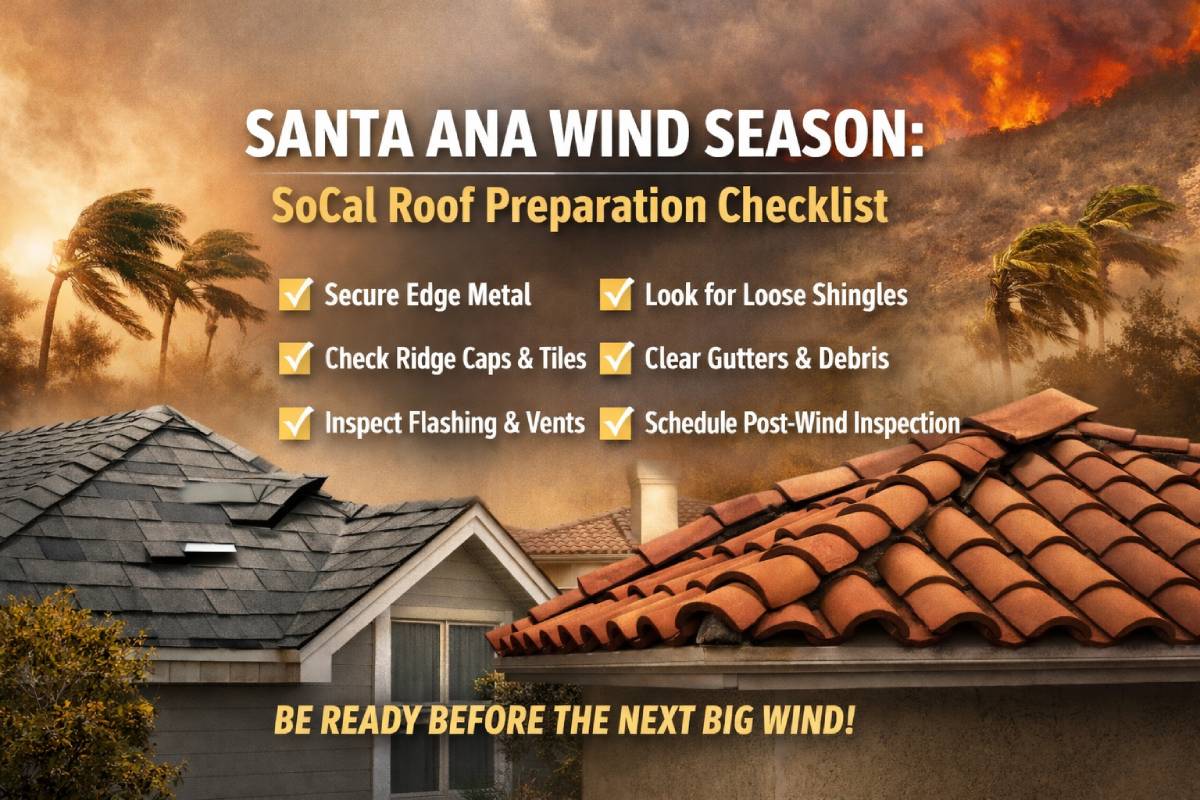
Santa Ana winds are a uniquely Southern California event—warm, very dry downslope winds that can cause property damage and rapidly worsen wildfire conditions. For roofs, the biggest problem isn’t always “a big dramatic blow-off.” It’s the small loosening (edge metal, ridge caps, lifted corners, cracked sealant) that turns into water intrusion the first time you get wind-driven rain.
Here’s a practical, roofer-approved checklist you can use before the next wind event—whether you’re a homeowner, property manager, or you’re simply trying to avoid emergency calls later.
1) Start at the edges: drip edge, fascia metal, and perimeter termination
Roof edges take the brunt of uplift forces. If wind gets under an edge, it can “peel” sections back like a tab on a can.
What to check:
- Loose, rattling, or separated edge metal
- Gaps at corners, miters, or transitions
- Old sealant that’s brittle, cracked, or missing
Why it matters:
Edge failures often lead to water entry at the eaves and damage to fascia/soffits—then you’re chasing rot, staining, and interior water intrusion.
2) Ridge caps and hips: the “zipper line” that wind loves
On many roof types, the ridge/hip line is where wind turbulence concentrates.
Look for:
- Ridge caps lifting at corners
- Cracked mortar on older tile ridges
- Missing fasteners or exposed nails
Pro tip: If you see one loose ridge cap, assume there may be more—wind rarely “targets” one spot.
3) Tile roofs: slipped, cracked, or unfastened tiles
Tile is durable, but wind can exploit weak spots—especially on older installations or roofs with previous repairs.
Quick visual checks (from the ground):
- Tiles that look “shifted” out of alignment
- Pieces on the ground after a windy night
- Exposed underlayment where tile has moved
Best practice: A professional inspection can safely verify whether tiles need re-fastening, replacement, or localized reset.
4) Shingle roofs: lifted tabs, missing starter, and “creeping” damage
Shingle damage can be subtle—especially right after the wind event.
Watch for:
- Lifted or “flapping” tabs
- Granules in downspouts and gutters
- Starter strip issues at the eaves/rakes
If shingles lift repeatedly, they can break seals and invite wind-driven rain under the field shingles.
5) Flashing and transitions: the most common water intrusion “starting points”
Even if your roof covering looks fine, wind can open tiny gaps around:
- Wall-to-roof intersections
- Chimneys
- Skylights
- Valleys
Old sealant is a frequent culprit—heat + UV + time turns it brittle, then wind does the rest.
6) Pipe boots, vents, and small penetrations
Small penetrations cause big headaches because they fail quietly.
Check:
- Cracked rubber boots
- Loose storm collars
- Sealant gaps around metal flashings
If you have a lot of penetrations (solar, HVAC lines, satellite mounts), this step becomes even more important.
7) Gutters and downspouts: don’t let debris become a roof problem
Santa Ana winds drop debris fast. If gutters clog, the next rain can back up water under edges and into fascia.
Do this:
- Clear gutters and roof valleys
- Confirm downspouts drain freely (not overflowing near foundations)
- Remove dry leaf piles that can also become ember fuel
8) “After the wind”: schedule a quick inspection before the next storm
The best time to find wind damage is immediately after the event—before rain tests every weak point.
A simple post-wind inspection typically focuses on:
- Roof perimeter and ridge details
- Flashing integrity
- Any lifted, cracked, or displaced materials
9) Consider a resilience upgrade if your roof is nearing replacement
If you’re planning a re-roof in the next year or two, ask about upgrades that improve performance in wind-driven rain. Research from Insurance Institute for Business & Home Safety shows strategies like a sealed roof deck can reduce water entry during wind-driven rain events compared to unsealed decks.
10) When to call a roofer immediately
Call promptly if you see:
- Missing shingles/tiles
- Exposed underlayment
- Metal edging peeled up
- Active leaks or new ceiling stains
If you’d like a pre-season wind inspection or repairs before the next Santa Ana event, Rocket Roofing can document your roof’s condition and fix small issues before they become expensive emergencies.
Owens Corning Roofing Products
Owens Corning Roofing Products
Rocket Roofing is proud to be selected as an Owen’s Corning Approved Roofing Contractor.
Owens Corning is a leader in roofing shingles, underlayment and components products. The look of a roof can have a significant impact on the overall design and perceived value of a home. After all, the roof can make up half of a home’s exterior.
Owens Corning systems look better, last longer and offer more choices to perfectly fit your project.
Rocket Roofing is proud to be selected as an Owen’s Corning Approved Roofing Contractor.
Owens Corning is a leader in roofing shingles, underlayment and components products. The look of a roof can have a significant impact on the overall design and perceived value of a home. After all, the roof can make up half of a home’s exterior.
Owens Corning systems look better, last longer and offer more choices to perfectly fit your project.