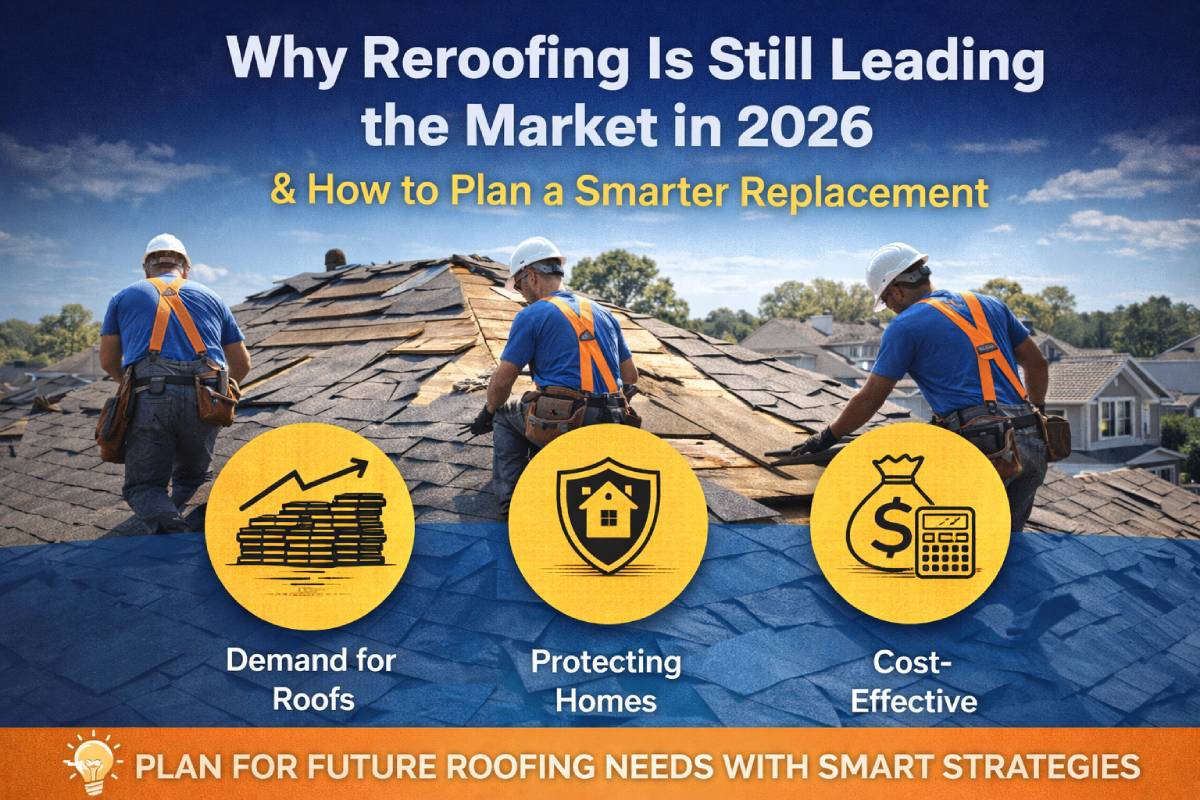
Why Reroofing Is Still Leading the Market in 2026
One of the clearest roofing trends is that reroofing remains the backbone of the market. Industry leaders expect that pattern to continue, even as new construction stays softer in some areas. At the same time, contractors are seeing more interest in cool roofs, solar options, and storm-ready materials. (Roofing Contractor)
That should sound familiar to Southern California homeowners.
A lot of roofing decisions in this region are not driven by brand-new homes. They are driven by existing roofs that have absorbed years of sun exposure, temperature swings, wind, debris, and deferred maintenance. In many cases, the real question is not whether the roof will need attention. It is whether the homeowner will deal with it proactively or wait until the problem becomes more disruptive.
That is why reroofing continues to lead.
For homeowners, reroofing is often less about excitement and more about timing. The roof may not be failing catastrophically. It may just be telling you, in quieter ways, that it is nearing the point where repairs stop being the smartest path. Granule loss, repeated patching, worn valleys, aging penetrations, brittle shingles, or recurring water intrusion points all add up. Individually, each issue may seem manageable. Together, they can point toward replacement as the more cost-effective long-term move.
The good news is that reroofing is not the same as reroofing ten or fifteen years ago. Homeowners have more choices. They can think not only about replacing old materials, but about upgrading the overall system for better durability, appearance, and future flexibility.
That system mindset matters. Owens Corning describes modern roofing as a complete system of coordinated components, not just shingles alone. That includes layers such as underlayment, barriers, and ventilation working together under changing conditions. (Owens Corning)
For homeowners, that means a smarter reroof is not just about picking a color and signing a contract. It is about understanding scope.
A strong reroofing plan usually starts with an honest inspection. What is actually worn out? What is still serviceable? Is the issue limited to the outer roofing material, or are there signs of decking trouble, flashing failures, weak ventilation, or areas that were never detailed well in the first place?
From there, it helps to define priorities. Some homeowners care most about longevity. Others are focused on curb appeal. Others want to prepare for solar later. Others simply want fewer repair surprises. There is no single right answer, but there is a right sequence: inspect first, define goals second, choose materials third.
Scheduling is also becoming more important. A homeowner survey found that many customers expect roofing work to begin within two weeks after accepting a quote. That sounds great, but it can also create unrealistic assumptions if homeowners wait until an emergency is already underway.
The smarter move is to start the conversation before the roof forces the issue.
That gives homeowners time to compare proposals carefully, review material options, ask about installation details, and make decisions without storm pressure or active water intrusion stress. It also makes it easier to coordinate related upgrades, whether that means gutters, ventilation improvements, or planning around future solar.
Another interesting point from the same survey: asphalt shingles still dominate homeowner roofs, and word-of-mouth plus search engines remain major ways people choose contractors. That reinforces something simple but important: most reroofing projects are still practical, local, trust-based decisions. Homeowners are not looking for hype. They are looking for clarity.
That is where contractors can really stand out. The best reroofing conversations are the ones that explain the “why,” not just the price. Why one underlayment is being recommended. Why a flashing detail matters. Why ventilation should be discussed. Why a full replacement may now be smarter than another patch. Why spending a little more in the right places can reduce the chance of future disruption.
In Southern California, reroofing also gives homeowners a chance to think ahead. This region creates a unique mix of priorities: heat, sun exposure, resale presentation, evolving insurance expectations, and long dry stretches interrupted by sudden weather events. A replacement roof should be chosen with those realities in mind.
That does not always mean choosing the most expensive option. It means choosing intentionally.
Reroofing is leading the market because existing roofs are where the action is. Homeowners are upgrading what they already own. They are protecting property value. They are solving deferred problems. They are trying to make one good decision now instead of several rushed decisions later.
That makes reroofing less of a repair story and more of a planning story.
When the project is approached that way, a new roof stops being just another home expense. It becomes a long-term improvement that protects the structure, improves appearance, and gives homeowners more control over what comes next.
Owens Corning Roofing Products
Owens Corning Roofing Products
Rocket Roofing is proud to be selected as an Owen’s Corning Approved Roofing Contractor.
Owens Corning is a leader in roofing shingles, underlayment and components products. The look of a roof can have a significant impact on the overall design and perceived value of a home. After all, the roof can make up half of a home’s exterior.
Owens Corning systems look better, last longer and offer more choices to perfectly fit your project.
Rocket Roofing is proud to be selected as an Owen’s Corning Approved Roofing Contractor.
Owens Corning is a leader in roofing shingles, underlayment and components products. The look of a roof can have a significant impact on the overall design and perceived value of a home. After all, the roof can make up half of a home’s exterior.
Owens Corning systems look better, last longer and offer more choices to perfectly fit your project.