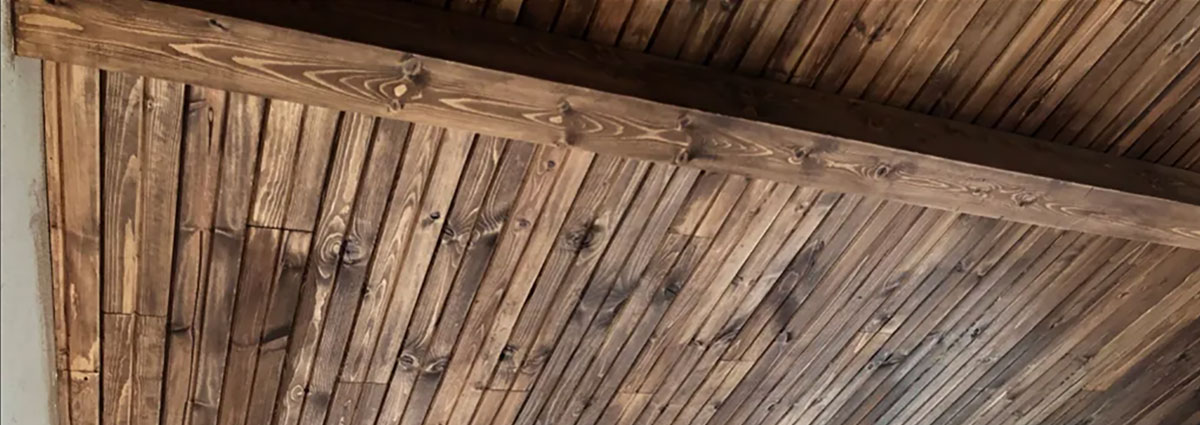
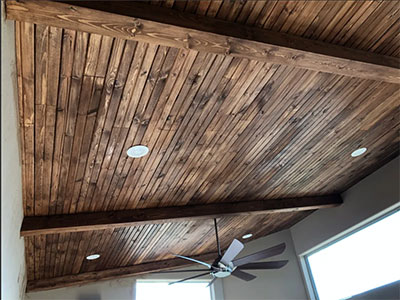
Tongue and groove ceilings can be problematic, and have overwhelming tendency to be associated with water, mold, or moisture problems.
Does your tongue and groove ceiling drip or leak water from your ceiling?
If you pull off some of the ceiling planks, you can see the real problem is condensation. Some may say to ventilate the ceiling. And if you added ventilation, the water problems can become worse, by increasing the condensation!
Why do tongue and groove ceilings drip when there’s no leak?
Boil a pot of water with a lid on it. Wait a minute then lift the lid. What do you see? Lots of water on the underside of the lid. There’s no ‘leak’ but yet the lid is covered with water due to condensation forming on it. This is exactly what’s happening inside your ceiling.
Under the right conditions, when water vapor in the air comes in contact with a surface cooler than the air, the water vapor becomes liquid water. If this happens enough, the water builds up and forms large drop of water. Those get large enough and, PLOP!, it starts raining in your house!
All too often, a Tongue and Groove ceiling is constructed in a way that virtually guarantees water problems. The roof is installed over the rafters. Fiberglass is shoved between the rafters. Tongue and Groove boards are nailed to the rafters, and now you can get mold, water “leaks”, and thousands of dollars of repairs which probably don’t even fix the problem.
Why don’t normal ceilings drip?
A typical ceiling is made of Sheetrock or plaster, and all the seams are carefully filled in. That’s then painted, usually with several coats of paint.
While some tiny amount of water vapor can get through the paint and Sheetrock, it’s a very small quantity. Small enough that, under normal conditions, natural air flow and moisture transfer removes the moisture that does get into the ceiling cavity above the Sheetrock.
However, even these ceilings often have problems when holes are cut in them for recessed lights. This allows that air and moisture to move much more quickly into the ceiling where it can condense and lead to mold growth and wood rot.
The key fact – if air gets into your ceiling, even through small holes, it will carry water vapor with it which is very likely to lead to moisture problems.
Why are Tongue and Groove ceilings so bad?
Water vapor is tiny. Really, really tiny. So tiny, that even the smallest crack is billions and billions of times larger than the water molecule. Tongue and groove ceilings may look ‘tight’ but to a water molecule, it’s like a wide open door! So that water vapor simply flows right up through those cracks and into the ceiling cavity above.
To Make matters worse, most ceilings are stuffed with fiberglass insulation, which doesn’t stop the water vapor at all. So the vapor keeps wafting up past the insulation until it reaches the underside of your roof. That roof deck is cold in the winter and on clear nights. When the vapor hits it, it condenses into liquid water. This is when the real problems start…
When it’s below freezing, the water freezes into ice. More water vapor enters, contacts the ice, and adds to the ice. Before you know it, the entire underside of the roof and anything else cold enough in the ceiling cavity, is covered with a layer of ice. This could go on for days, weeks or even months until the ice melts and it starts raining in your living room!
Even when it’s not below freezing, in most climates, it gets cold enough and there’s enough water vapor carried by the air for condensation to form inside the ceiling. The wood can absorb some of that moisture and slowly transfer it out. But with a Tongue and Groove ceiling, the water supply inside the house is nearly infinite, so it keeps building up. Pretty soon, the wood is saturated and larger water droplets form. They’ll drip down, following gravity, until they find a place to leak out. That’s why the drips often form far away from where the condensation is actually occurring, which is often high up the ceiling.
Will ventilation solve the problem?
Builders are taught that roofs have to be ventilated in order to ‘flush out’ the moisture. The problem is, that doesn’t work with Tongue and Groove ceilings. In fact, it often makes problems worse.
Why? As the air moves through the cavity, it has a tendency to draw more air from the inside of the house into the cavity. Some of that is flushed out with the air moving through the cavity. But when the water vapor carried by the air comes in contact with cold surfaces, it basically sticks. If there’s enough, which there usually is in a house during winter, then you still have the condensation problem.
How do you prevent water vapor from getting in the ceiling?
Take a step back. What ceilings work properly? We started discussing how a typical drywall ceiling usually doesn’t have moisture problems like these (unless you put holes in it). So the easiest solution is to build a normal drywall ceiling over which you install the Tongue and Groove boards – purely for aesthetic purposes. Drywall is cheap. Replacing your roof is expensive.
What about plastic sheeting?
Drywall is cheap. Replacing your roof is expensive. Some builders try to ‘cheap out’ by just putting plastic up, usually with thousands of staples, then nailing the Tongue and Groove boards to the rafters, with thousands more nails.
Do you think a sheet of plastic with thousands of holes in it is going to stop the movement of water vapor, one of the tiniest molecules in nature, from getting into the ceiling? Maybe it will take 5 years to rot out the roof instead of 3. But eventually, you’re going to be spending many thousands of dollars for a new roof, just because the builder decided to take the cheap approach and save a little bit of drywall.
What could be done differently?
You could add a thin sheet of foil faced polyiso sheet foam across the rafters before installing the Tongue and Groove ceiling to add another layer of moisture barrier and to reduce thermal bridging through the wooden rafters. In extremely cold climates, this would be highly recommended as you could still get condensation on the exposed rafters because they transmit the cold much more than the insulation.
My ceiling is installed can if seal it?
NO. That might slow the process slightly, but eventually you’re going to regret the decision when your roof rots out and your ceiling is filled with mold. Shortcuts don’t work with Tongue and Groove ceilings. You have to do them right, or you’ll pay the price eventually.
Owens Corning Roofing Products
Owens Corning Roofing Products
Rocket Roofing is proud to be selected as an Owen’s Corning Approved Roofing Contractor.
Owens Corning is a leader in roofing shingles, underlayment and components products. The look of a roof can have a significant impact on the overall design and perceived value of a home. After all, the roof can make up half of a home’s exterior.
Owens Corning systems look better, last longer and offer more choices to perfectly fit your project.
Rocket Roofing is proud to be selected as an Owen’s Corning Approved Roofing Contractor.
Owens Corning is a leader in roofing shingles, underlayment and components products. The look of a roof can have a significant impact on the overall design and perceived value of a home. After all, the roof can make up half of a home’s exterior.
Owens Corning systems look better, last longer and offer more choices to perfectly fit your project.