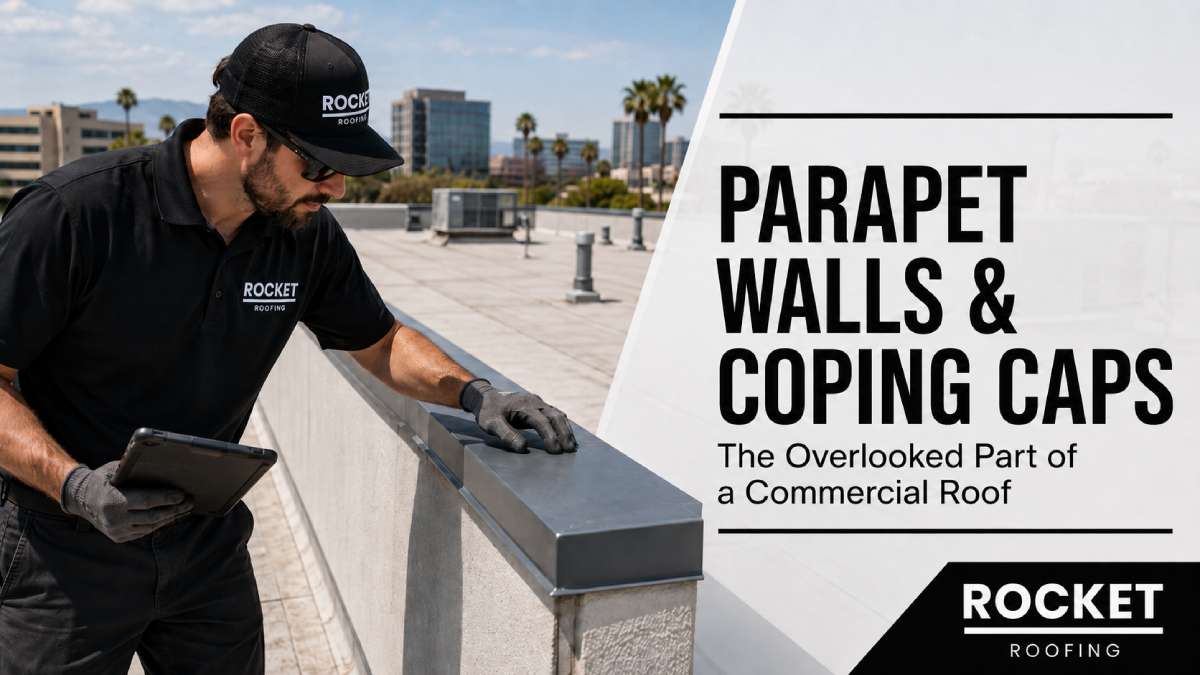
The Overlooked Part of a Commercial Roof: Why Parapet Walls and Coping Caps Matter
When commercial property owners think about their roofs, most attention naturally goes to the large horizontal roofing surface.
Is the membrane in good condition? Are the drains clear? Are the seams secure? Is there damage around rooftop HVAC equipment?
Those are important questions.
But some of the most important areas of a commercial roofing system are actually located above and around the roof surface.
Parapet walls and coping caps are a perfect example.
These perimeter components help protect the roof edge and building envelope, yet they can easily be overlooked during routine property maintenance.
What Is a Parapet Wall?
A parapet is the portion of an exterior wall that extends above the roofline.
They are common on:
- Shopping centers
- Office buildings
- Industrial properties
- Warehouses
- Apartment buildings
- Medical facilities
- Restaurants
- Retail buildings
Parapets can hide rooftop equipment from street view, provide architectural detail, and form part of the perimeter of a low-slope roofing system.
They also create one of the places where horizontal and vertical building surfaces meet—which means the details need to work together.
The National Roofing Contractors Association notes that parapets play an important role at roof edges, including helping protect roof assemblies from wind-uplift forces.
What Is the Coping Cap?
Look at the very top of many commercial parapet walls and you will see metal running along the perimeter.
That is commonly called coping.
Coping covers and protects the top of the parapet wall. NRCA guidance describes coping as a weather-resistant cap designed to protect parapet walls and adjacent building components.
It may seem like a small architectural detail, but it is an important part of the overall roof and wall system.
Why Southern California Can Be Tough on Roof-Edge Metal
Commercial roofs in Southern California can experience long periods of intense sunshine followed by cooler nighttime temperatures, seasonal winds, rain events, and years of exposure.
Metal components expand and contract as temperatures change.
Over time, roof-edge components may develop issues such as:
- Loose coping sections
- Open joints
- Failed sealants
- Missing fasteners
- Corrosion
- Separation at seams
- Movement at corners
- Damage from previous repairs
- Deterioration where the roof membrane meets the wall
Even a relatively small problem along hundreds of feet of roof perimeter can become important.
Do Not Inspect Only the Middle of the Roof
One mistake during a commercial roof assessment is focusing almost entirely on the field of the roof.
A more complete inspection should also evaluate transition areas.
That can include:
- Parapet walls
- Coping caps
- Roof-to-wall transitions
- Flashing
- Membrane terminations
- Corners
- Drains
- Scuppers
- Equipment curbs
- Roof penetrations
- Expansion areas where applicable
These locations often involve multiple materials and installation details meeting in a relatively small area.
That makes workmanship and ongoing maintenance especially important.
Wind Can Put Extra Stress on Roof Perimeters
Roof edges deserve particular attention because wind pressures are not distributed evenly across an entire building.
Perimeters and corners can experience significant wind forces.
This matters in Southern California communities affected by Santa Ana wind events.
If edge metal, fasteners, or coping components are already loose, wind can potentially worsen an existing problem.
A visual inspection after significant wind events can help identify displaced or damaged materials before the condition becomes more extensive.
Watch for These Warning Signs
Commercial building owners and facility managers should pay attention to visible changes around parapets and coping.
Potential warning signs include:
- Metal sections that appear raised or uneven
- Open coping joints
- Loose corners
- Missing fasteners
- Cracked or deteriorated sealant
- Rust or corrosion
- Cracks in parapet surfaces
- Deteriorated roof-to-wall flashing
- Membrane pulling away from vertical surfaces
- >Previous repair areas beginning to separate
Some conditions can be difficult to see from ground level, which is why routine professional roof inspections are valuable.
Small Perimeter Repairs Can Protect a Much Larger Roof
The roof edge represents a relatively small percentage of the total roofing area, but it should not be treated as an afterthought.
Catching deteriorated coping, flashing, or roof-to-wall details early may allow targeted maintenance or repairs before larger areas are affected.
The same principle applies when replacing a commercial roof.
A new roof membrane should be considered together with the perimeter details, drains, flashings, penetrations, equipment curbs, and other components that complete the roofing system.
Replacing the field of the roof while ignoring deteriorated edge conditions can leave important vulnerabilities unresolved.
Make Roof Perimeters Part of Your Maintenance Plan
Commercial roofing is an asset that should be managed, not simply repaired when something goes wrong.
Include roof edges and parapet conditions in routine inspections and document changes over time with photographs.
This makes it easier to identify movement, deterioration, or recurring trouble spots.
If you own or manage a commercial property in Southern California, Rocket Roofing can inspect your commercial roofing system and help identify areas that may need maintenance, repair, restoration, or replacement.
Sometimes the most important part of your roof is not in the middle—it is around the edge.
Owens Corning Roofing Products
Owens Corning Roofing Products
Rocket Roofing is proud to be selected as an Owen’s Corning Approved Roofing Contractor.
Owens Corning is a leader in roofing shingles, underlayment and components products. The look of a roof can have a significant impact on the overall design and perceived value of a home. After all, the roof can make up half of a home’s exterior.
Owens Corning systems look better, last longer and offer more choices to perfectly fit your project.
Rocket Roofing is proud to be selected as an Owen’s Corning Approved Roofing Contractor.
Owens Corning is a leader in roofing shingles, underlayment and components products. The look of a roof can have a significant impact on the overall design and perceived value of a home. After all, the roof can make up half of a home’s exterior.
Owens Corning systems look better, last longer and offer more choices to perfectly fit your project.