The Commercial Roof Leak You Cannot See: How Moisture Mapping Finds Hidden Damage
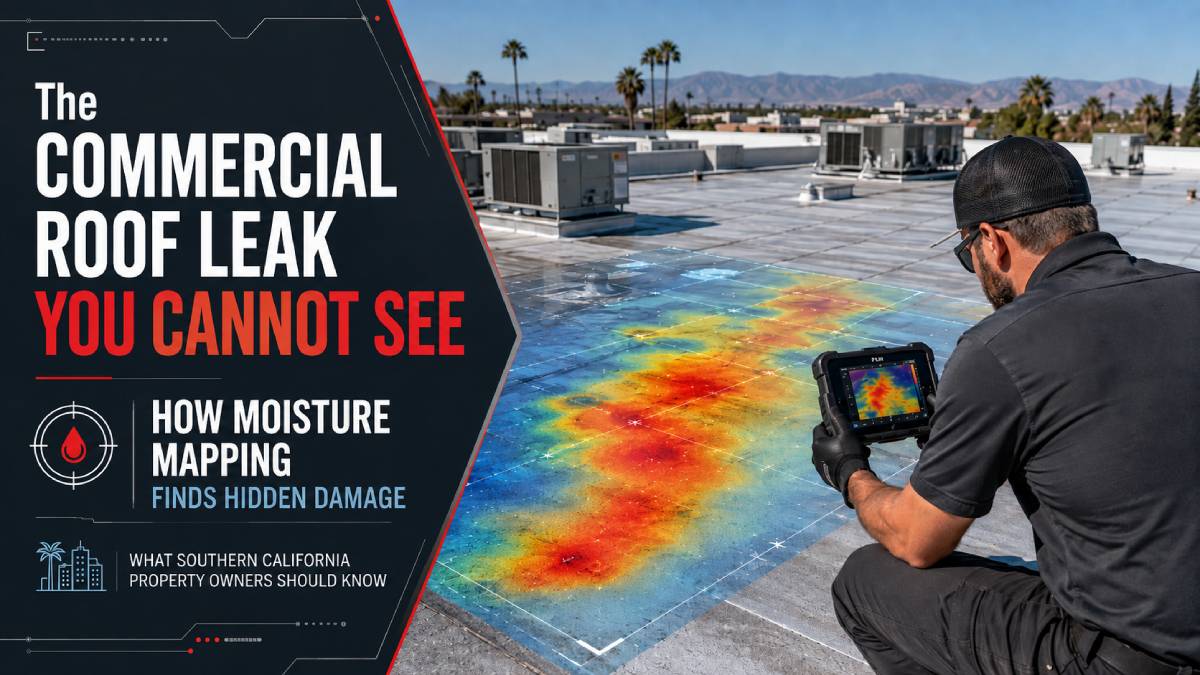
A commercial roof can stop visibly leaking while moisture remains trapped inside the roofing system.
Water may enter through a puncture, open seam, damaged flashing or failed rooftop penetration. It can then spread horizontally through insulation or between roofing layers before appearing inside the building.
By the time water stains become visible on a ceiling, the affected area above may be much larger than the interior stain suggests.
This is why a visual inspection alone may not provide enough information when planning a commercial roof repair, coating or replacement.
What Is a Roof Moisture Survey?
A roof moisture survey uses specialized equipment to identify areas beneath the roof membrane that may contain elevated moisture.
Depending on the roof assembly and project, diagnostic methods can include:
- Infrared thermography
- Electrical capacitance
- Nuclear moisture testing
- Electronic leak detection
- Moisture probes
- Test cuts or core samples
Each method measures a different property. The correct approach depends on the membrane, insulation, deck, weather conditions and purpose of the inspection.
The survey does not simply look for water sitting on top of the roof. Its purpose is to evaluate conditions within the roofing assembly.
How Infrared Roof Scanning Works
Wet and dry roofing materials can heat and cool at different rates.
After the roof has been warmed by the sun, moisture-containing areas may retain heat differently than dry sections. An infrared camera can detect these temperature patterns and help identify areas that require further investigation.
Infrared scanning is considered a nondestructive testing method because the camera can evaluate large areas without initially cutting into the roof.
NRCA research has documented the use of infrared temperature differences to locate suspected wet insulation. That research also emphasizes verifying infrared findings with selected core samples or other physical testing because roof equipment and construction differences can sometimes produce similar thermal patterns. (nrca.net)
In other words, an infrared image is an important diagnostic tool, but it should be interpreted by someone who understands roofing systems.
Why Wet Insulation Is a Serious Problem
Commercial roofing insulation is intended to help control heat transfer through the building envelope.
When certain insulation materials become wet, their thermal resistance can decrease. Studies summarized by the NRCA have found that moisture can significantly reduce the thermal performance of common roof insulations. (nrca.net)
Wet insulation may contribute to:
- Reduced energy efficiency
- Additional strain on HVAC equipment
- Deteriorated roof components
- Loss of adhesion
- Mold or organic growth
- Corrosion of metal components
- Soft or unstable areas
- Continued migration of moisture
- Premature roof-system failure
The visible leak may be repaired, but the roof is not fully restored if saturated material remains trapped underneath.
Moisture Mapping Before a Roof Coating
Roof coatings can be a useful restoration option when the existing roof is a suitable candidate.
However, a coating should not simply be installed over widespread wet insulation or a deteriorated substrate. Covering trapped moisture can preserve the underlying problem instead of solving it.
GAF identifies widespread moisture or moisture-saturated substrates as factors that can make a commercial roof a poor candidate for coating. A roof generally needs to be sufficiently dry, repairable and structurally sound before restoration is considered. (GAF)
A moisture survey can help determine whether:
- The roof is mostly dry
- Wet areas are isolated
- Targeted insulation replacement is practical
- Large sections need to be removed
- A coating remains a viable option
- Complete replacement is the better investment
This gives the building owner more information before committing to a restoration system.
Moisture Mapping Before Roof Replacement
Moisture surveys can also improve replacement planning.
Without diagnostic testing, a contractor may not know how much wet insulation or damaged material will need to be removed until the project is underway. This can lead to change orders, unexpected disposal costs and construction delays.
Mapping suspected wet areas before work begins can help the roofing team:
- Estimate removal quantities
- Plan material deliveries
- Develop realistic allowances
- Identify possible deck repairs
- Reduce unexpected project changes
- Create a more accurate project scope
Testing cannot eliminate every surprise, but it can provide a clearer picture than surface observations alone.
Infrared Scanning and Electronic Leak Detection Are Different
Infrared moisture scanning and electronic leak detection are sometimes treated as interchangeable, but they answer different questions.
An infrared survey generally looks for thermal patterns that may indicate moisture already trapped within the roof assembly.
Electronic leak detection is designed to locate breaches or discontinuities in a waterproofing membrane. Certain ELD methods can identify openings that are too small to be found during a normal visual inspection.
A commercial roof may benefit from one method or a combination of methods depending on whether the objective is to:
- Locate an active breach
- Map existing wet insulation
- Verify a new installation
- Prepare for restoration
- Investigate recurring leaks
- Develop a replacement budget
When Should a Building Owner Consider Moisture Testing?
A roof moisture survey may be valuable when:
- Leaks keep returning after repairs
- Interior stains do not match visible roof damage
- The roof has experienced years of deferred maintenance
- A coating is being considered
- The building is being purchased or sold
- A replacement budget is being prepared
- Energy use has increased without a clear explanation
- The roof contains large insulated areas
- There are concerns about moisture around rooftop equipment
- The existing roof has experienced storm or drainage problems
The survey should be combined with a complete visual inspection of the membrane, flashing, seams, drains, penetrations and rooftop equipment.
Turn the Findings into a Roof Plan
A moisture map is most useful when it leads to a clear repair or replacement strategy.
The final evaluation should explain:
- Where moisture is suspected
- How the findings were verified
- Which roofing components are affected
- Whether the damage appears isolated or widespread
- Which areas should be removed
- Whether restoration is still feasible
- Which repairs should be prioritized
- How future moisture entry can be prevented
Property owners should receive documentation that can be used for maintenance planning, capital budgeting and contractor discussions.
Make Commercial Roofing Decisions with Better Information
Commercial roof problems are not always visible from the surface. A membrane can appear intact while insulation beneath it is holding moisture and losing performance.
Infrared scanning, electronic leak detection and verification testing give property owners a more complete understanding of the roof before approving a coating, repair or replacement.
Rocket Roofing works with built-up, modified bitumen, EPDM, PVC, TPO and other commercial roofing systems throughout Southern California.
Contact Rocket Roofing to schedule a commercial roof inspection and discuss whether moisture testing should be part of your building’s maintenance or replacement plan.
Owens Corning Roofing Products
Owens Corning Roofing Products
Rocket Roofing is proud to be selected as an Owen’s Corning Approved Roofing Contractor.
Owens Corning is a leader in roofing shingles, underlayment and components products. The look of a roof can have a significant impact on the overall design and perceived value of a home. After all, the roof can make up half of a home’s exterior.
Owens Corning systems look better, last longer and offer more choices to perfectly fit your project.
Rocket Roofing is proud to be selected as an Owen’s Corning Approved Roofing Contractor.
Owens Corning is a leader in roofing shingles, underlayment and components products. The look of a roof can have a significant impact on the overall design and perceived value of a home. After all, the roof can make up half of a home’s exterior.
Owens Corning systems look better, last longer and offer more choices to perfectly fit your project.